
Chronic pain is one of the most common reasons people seek chiropractic and rehabilitation care. Whether it stems from sports injuries, repetitive strain, aging joints, or unresolved soft tissue damage, persistent pain can significantly affect mobility, productivity, and quality of life.
Many patients cycle through rest, medications, stretching routines, injections, or physical therapy—only to experience temporary relief or recurring symptoms. This is because many chronic conditions are not simply “inflammatory problems,” but rather failed healing problems.
In recent years, a treatment known as shockwave therapy has emerged as a powerful, science-backed option for stimulating true tissue repair. Instead of masking pain, it helps restart the body’s natural healing mechanisms at the cellular level.
This article provides a comprehensive breakdown of how shockwave therapy works, why it accelerates tissue repair, what conditions it treats, and what patients can realistically expect from care.
To understand why shockwave therapy is effective, it’s important to understand why some injuries become chronic in the first place.
When tissue is injured—such as a tendon strain, ligament sprain, or muscle tear—the body initiates a healing response involving inflammation, repair, and remodeling. In an ideal situation, this process restores full function.
However, several factors can interrupt or stall healing:
Poor blood circulation in tendons and ligaments
Repetitive stress before full recovery
Aging and reduced cellular activity
Scar tissue formation instead of healthy tissue
Chronic inflammation that never fully resolves
Mechanical imbalances in movement patterns
When this happens, the tissue becomes degenerative rather than regenerative. Instead of rebuilding strong collagen fibers, the body produces weaker, disorganized tissue that cannot tolerate normal stress.
This is where chronic pain begins—and why traditional symptom-based treatments often fail to solve the root issue.
Shockwave therapy targets this exact problem: the failure of tissue to heal properly.
Shockwave therapy, also known as Extracorporeal Shockwave Therapy (ESWT), is a non-invasive treatment that uses high-energy acoustic waves to stimulate biological healing in damaged tissues.
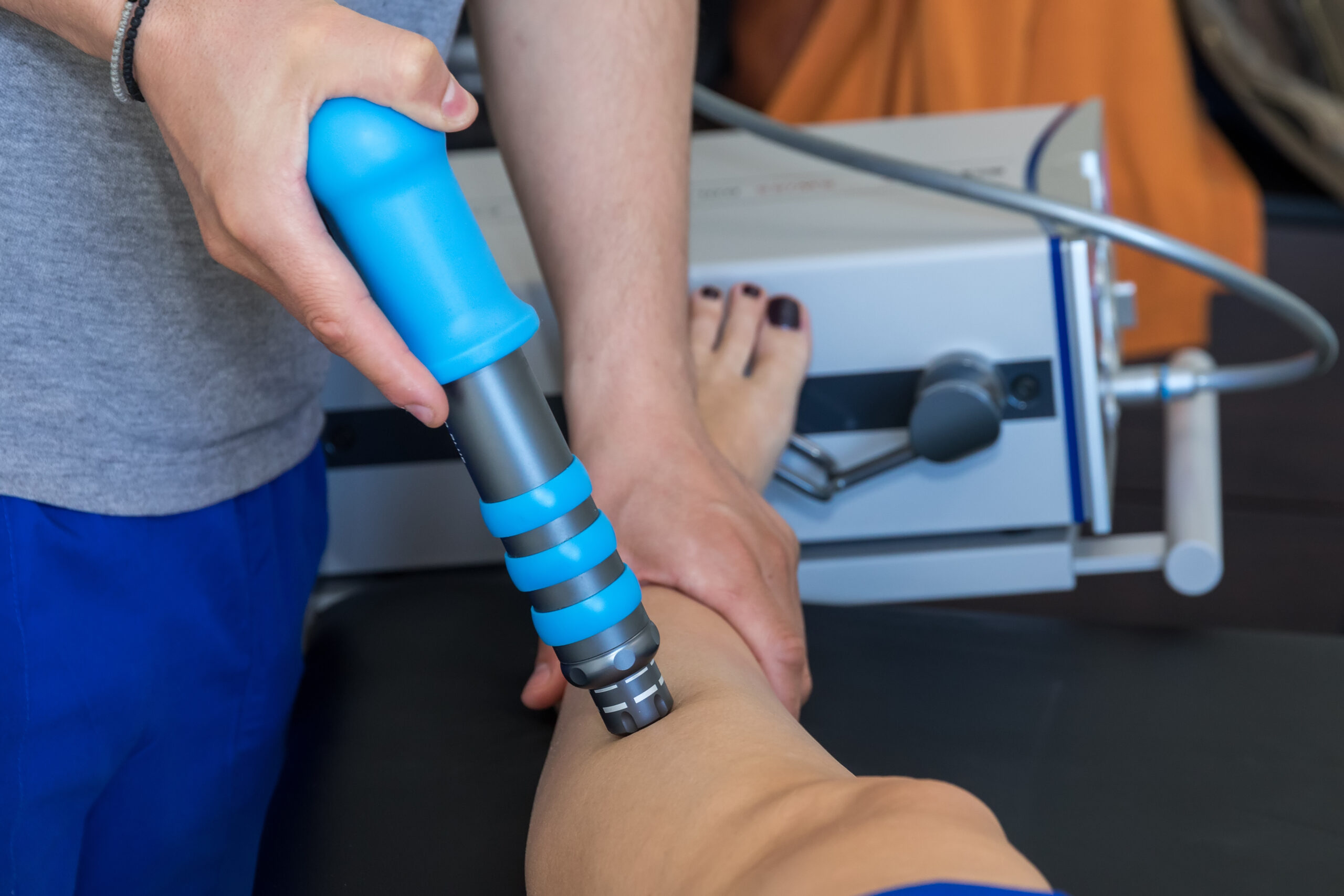
These acoustic waves are delivered through a handheld device placed on the skin over the injured area. The energy travels deep into muscles, tendons, ligaments, and connective tissue.
Unlike ultrasound or massage, shockwave therapy does not simply relax tissue—it creates controlled mechanical stimulation that triggers the body’s repair systems.
Originally developed for breaking up kidney stones, shockwave technology has been adapted for musculoskeletal medicine and is now widely used in:
Chiropractic care
Sports medicine
Physical therapy clinics
Orthopedic rehabilitation programs
Its popularity has grown because it addresses chronic injuries that often do not respond to conventional care.
Shockwave therapy works by stimulating the body through multiple biological pathways at the same time, making it more effective than treatments that focus on a single mechanism. The acoustic waves trigger mechanical stress in damaged tissues, which activates cellular repair processes, increases blood circulation, and promotes the formation of new blood vessels. It also helps break down scar tissue and calcifications while reducing chronic inflammation that can slow healing. At the same time, it influences nerve activity to reduce pain signals. This combined response encourages faster tissue regeneration, improved structural repair, and long-term recovery in injured muscles, tendons, and ligaments.
One of the biggest barriers to healing in chronic injuries is poor circulation.
Tendons and ligaments naturally have limited blood supply, which means injuries in these areas heal slowly or incompletely.
Shockwave therapy improves circulation by:
Expanding existing blood vessels
Increasing microvascular activity
Enhancing oxygen delivery to tissues
Improving nutrient transport to damaged cells
With improved blood flow, the injured area receives the essential components needed for regeneration.
Without this step, healing remains stalled.
At the cellular level, shockwave therapy creates controlled mechanical stress known as mechanotransduction.
Cells respond to this mechanical energy by activating repair pathways. This leads to:
Increased fibroblast activity
Enhanced collagen synthesis
Accelerated tissue remodeling
Improved structural integrity of tendons and ligaments
Collagen is the primary structural protein in connective tissue. When shockwave therapy stimulates collagen production, it helps rebuild stronger and more organized tissue fibers.
Over time, this improves durability and reduces reinjury risk.
Chronic injuries often lead to the formation of:
Fibrotic scar tissue
Hardened collagen deposits
Calcium buildup in tendons (calcific tendinopathy)
These abnormal structures restrict movement, create stiffness, and generate pain signals.
Shockwave therapy helps by:
Fragmenting calcified deposits
Softening dense scar tissue
Encouraging replacement with healthy tissue
This is especially beneficial in long-standing injuries where stiffness and restricted motion are major complaints.
As tissue quality improves, movement becomes smoother and less painful.
Inflammation is essential for healing, but when it becomes chronic, it becomes destructive rather than restorative.
In chronic pain conditions, the body often remains in a constant low-grade inflammatory state, preventing proper healing cycles from completing.
Shockwave therapy helps regulate inflammation by:
Reducing inflammatory mediators
Improving metabolic waste clearance
Stimulating a fresh healing response
Instead of endlessly repeating the inflammatory phase, the body is encouraged to progress into repair and remodeling.
This shift is critical for long-term recovery.
Another powerful effect of shockwave therapy is angiogenesis, the formation of new blood vessels.
New blood vessel growth improves:
Oxygen delivery
Nutrient supply
Long-term tissue vitality
This is especially important in tendons and ligaments, where natural blood flow is already limited.
By improving vascularization, shockwave therapy supports ongoing healing even after treatment sessions are completed.
Shockwave therapy also affects the nervous system’s perception of pain.
It can reduce pain by:
Desensitizing local nerve endings
Decreasing substance P (a pain neurotransmitter)
Interrupting chronic pain feedback loops
This helps reduce pain sensitivity, allowing patients to move more comfortably during the healing process.
Pain reduction is often noticeable early in treatment, even before full structural healing occurs.
Shockwave therapy is commonly used for chronic musculoskeletal conditions, especially those that involve long-term pain, inflammation, or poor tissue healing. These conditions often include plantar fasciitis, Achilles tendonitis, patellar tendonitis (jumper’s knee), tennis elbow, and golfer’s elbow. It is also frequently applied to shoulder injuries such as rotator cuff tendinopathy and impingement syndrome, as well as hip pain and bursitis. In addition, it can help with chronic muscle tightness, trigger points, and scar tissue-related restrictions. These conditions are often slow to heal because of limited blood flow or repetitive stress, making shockwave therapy a valuable non-invasive treatment option for recovery.
Plantar fasciitis
Achilles tendonitis
Patellar tendonitis (jumper’s knee)
Hip pain and bursitis
Tennis elbow (lateral epicondylitis)
Golfer’s elbow (medial epicondylitis)
Rotator cuff tendinopathy
Shoulder impingement syndrome
Muscle trigger points
Scar tissue-related stiffness
Overuse injuries
Chronic ligament strain
It is especially effective for injuries that have persisted for more than 6–12 weeks without improvement.
A typical shockwave therapy session is straightforward and non-invasive, making it easy for most patients to tolerate. The treatment begins with a clinician identifying the exact area of pain or dysfunction. A conductive gel is applied to the skin, and a handheld device delivers controlled acoustic waves into the affected tissue. Patients may feel a tapping or pulsing sensation, which can range from mild to moderately uncomfortable depending on the condition being treated. Each session usually lasts about 10 to 20 minutes. There is no need for anesthesia or downtime, and most patients can resume normal daily activities immediately afterward.
A gel is applied to the skin
A handheld device delivers acoustic pulses
You may feel tapping or pressure sensations
Intensity is adjusted for comfort
Mild soreness similar to post-exercise fatigue
Temporary sensitivity in treated area
Gradual reduction in pain over time
Each session typically lasts 10–20 minutes, depending on the condition being treated.
Most patients return to normal daily activities immediately after treatment.
Treatment plans for shockwave therapy vary depending on the severity and duration of the condition. Acute or mild cases may require fewer sessions, while chronic or long-standing injuries often need a longer treatment course. A clinician adjusts intensity and frequency to match the patient’s healing response and goals.
General guidelines:
Acute or mild injuries: 3–4 sessions
Moderate chronic injuries: 4–6 sessions
Severe or long-term conditions: 6–10 sessions
Sessions are usually spaced one week apart to allow the body time to respond and rebuild tissue between treatments.
Improvement is often gradual, with many patients noticing steady progress over several weeks.
Shockwave therapy offers several advantages compared to traditional treatment methods:
Non-surgical and non-invasive
No medication required
No downtime after treatment
Targets root cause of pain
Encourages natural tissue healing
Improves long-term function
Reduces recurrence of injury
It is particularly beneficial for patients who want to avoid surgery or long-term reliance on pain medications.
While shockwave therapy is highly effective for many chronic musculoskeletal conditions, it is not suitable for all cases. It is generally not recommended for acute infections, areas with active inflammation due to systemic disease, or patients with certain blood clotting disorders. It should also be avoided over malignant tumors, open wounds, or during pregnancy in the treatment area. In some severe structural injuries, such as complete tendon or ligament tears, surgical intervention may be necessary instead. A proper clinical assessment is essential before starting treatment to ensure safety, determine suitability, and choose the most appropriate and effective care plan for each patient.
It may not be appropriate for:
Acute infections
Certain blood clotting disorders
Pregnancy (in treatment area)
Severe structural tears requiring surgery
A proper clinical evaluation is essential before beginning treatment.
1. Is shockwave therapy safe?
Yes. It is a clinically approved, non-invasive treatment widely used in rehabilitation medicine.
2. How quickly will I feel results?
Some patients notice improvement within a few sessions, while others experience gradual relief over several weeks.
3. Does shockwave therapy permanently fix pain?
It can provide long-term improvement by addressing tissue damage rather than just masking symptoms. Results depend on the condition and patient compliance with rehabilitation.
4. Can I exercise after treatment?
Light activity is usually allowed, but heavy or high-impact exercise may be temporarily limited depending on the condition.
5. Is shockwave therapy painful?
Discomfort is typically mild to moderate and short-lived. Settings are adjusted for patient tolerance.
6. Why choose shockwave therapy instead of injections?
Unlike injections that temporarily reduce inflammation, shockwave therapy promotes actual tissue regeneration and long-term healing.
Shockwave therapy represents a major advancement in the treatment of chronic musculoskeletal pain by directly targeting the underlying causes of dysfunction rather than only masking symptoms. It works by stimulating blood flow to poorly perfused tissues, activating cellular repair mechanisms, breaking down scar tissue, and reducing chronic inflammation that often prevents proper healing. In addition, it enhances nerve function, helping to normalize pain signaling and improve overall tissue responsiveness. These combined effects create an environment where damaged muscles, tendons, and ligaments can regenerate more effectively.
For individuals who have struggled with persistent pain that has not improved through rest, medication, or traditional therapy, shockwave therapy offers a scientifically supported, non-invasive treatment option. Instead of temporary relief, it promotes true biological healing. By encouraging the body to rebuild and restore injured structures, it supports long-term recovery, improved mobility, and a higher overall quality of life for patients dealing with chronic conditions.
If you are dealing with chronic pain, lingering sports injuries, or soft tissue conditions that haven’t improved with traditional care, shockwave therapy may be the solution you’ve been looking for.
Faulkenberry Chiropractic — Contact Details
Address: 11125 Arcade Dr, STE D, Little Rock, AR 72212
Phone: (501) 225-1371
Email: faulkenberrychiro@gmail.com
Website: www.faulkenberrychiropractic.com
👉 Contact us today to schedule a consultation and learn whether shockwave therapy is right for your condition and recovery goals.
